Home, to start
Lower entry cost, faster license, and the only route that lets you test demand before signing a lease. Most center owners started here.
These are two different businesses with the same customers. One licenses a house and one licenses a building, and almost everything downstream follows from that.
Lower entry cost, faster license, and the only route that lets you test demand before signing a lease. Most center owners started here.
Capacity, staff cover and the ability to be ill without closing. A home program has a hard ceiling and no redundancy.
A homeowner policy usually excludes child care. It is the difference most home providers discover late.

A home program is licensed as a home. That means the household is part of the application — background checks for every adult who lives there and often for anyone regularly present — and the inspection covers rooms a provider thinks of as private.
A center is licensed as a facility, with a named qualified director on the license, commercial zoning, fire and health inspections against commercial standards, and staff qualification records for everybody.
Most states also run tiers within home care: a smaller registered or certified tier and a larger group tier with center-like ratios and an assistant. The threshold between them is a head count that usually includes the provider's own children.
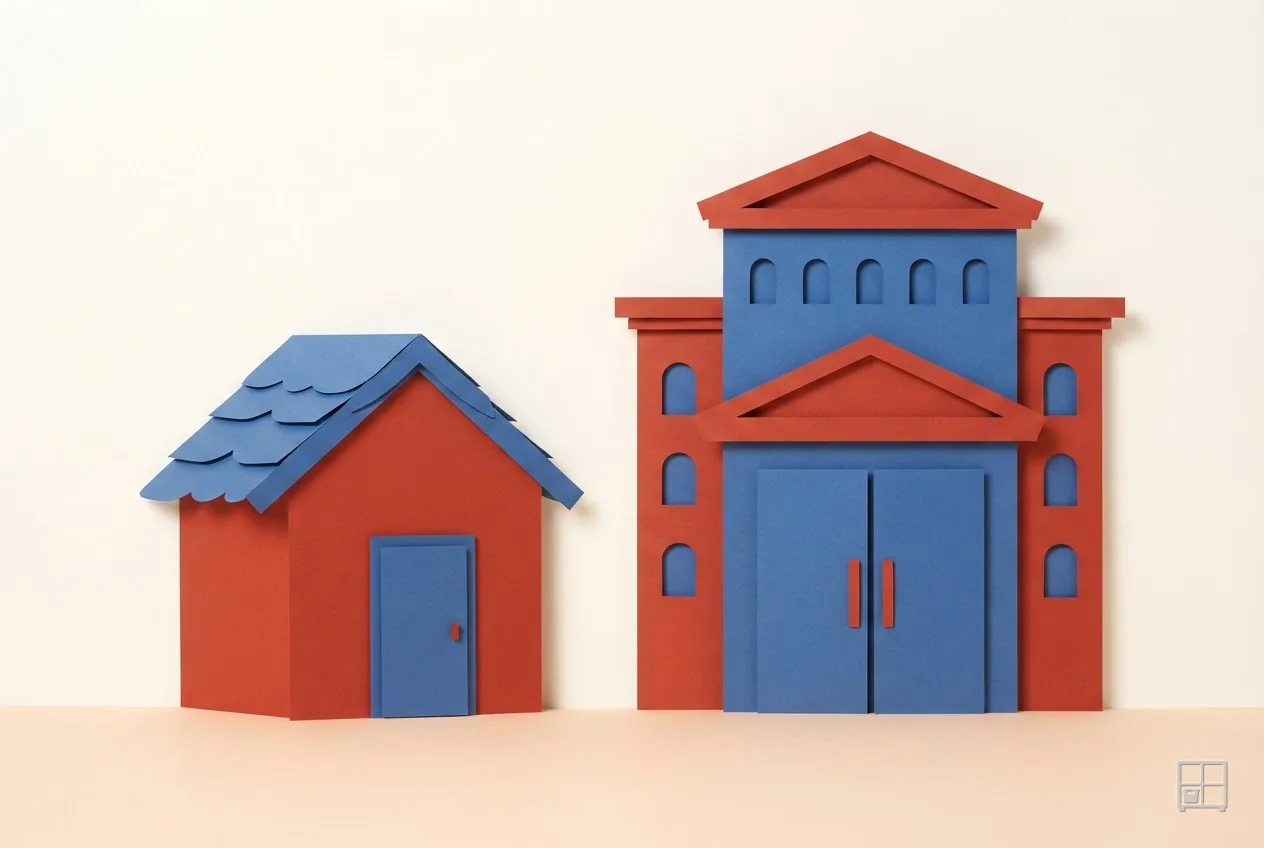
The entry costs are not comparable. A home program buys equipment, safety fittings, insurance and a license. A center buys a lease, a build-out dominated by bathrooms and a kitchen, furniture for several rooms, and months of payroll before enrollment covers it.
The ceilings are not comparable either. A home program is capped by the license at a single-figure or low-double-figure head count and by the fact that one person cannot be ill. A center's ceiling is the building.
Between the two sits the group home tier, which is where a lot of successful home providers end up: more capacity, an assistant, still a house.
| Home program | Center | |
|---|---|---|
| Licensed as | A home, household included | A facility |
| Background checks | Provider + household adults | All staff |
| Entry cost | Equipment, safety, insurance | Lease, build-out, equipment, runway |
| Capacity | Set by tier and own children | Set by the building |
| Cover when ill | Usually none | Other staff |
| Insurance | Homeowner policy usually excludes it | Commercial policy |
| Food program | Via a sponsor, two tiers | Direct, three categories |
Structural differences that hold in most states. Every number and threshold is state-specific — check yours.
Both can claim CACFP, and the rate structures differ. Centers are reimbursed by the child's eligibility category — for July 2026 through June 2027 in the contiguous states, $2.54 for a free-rate breakfast, $4.76 for a free-rate lunch or supper, $1.30 for a free-rate snack, and $0.42, $0.45 and $0.12 at the paid rate.
Homes are reimbursed at one of two tiers, and they claim through a sponsoring organization rather than directly: breakfast $1.74 Tier I and $0.62 Tier II, lunch or supper $3.31 and $1.99, snack $0.98 and $0.27.
For a Tier I home serving three reimbursable meals a day the money is meaningful against a food cost you carry anyway — which is why sponsors exist and why joining early is worth the paperwork.
Start at home if you want to test demand, learn the operational reality and license quickly. It is the cheapest possible education in whether you want to do this at all, and the license is real. Whichever route you take, the business structure is its own decision; see LLC vs sole proprietorship for daycare.
Go straight to a center if you already have the capital, a building that can be licensed, and a qualified director — including if that is you. The runway, not the build-out, is the number to be honest about.
And do not treat the home route as the lesser one. A well-run group home program with a waiting list is a better business than a half-full center carrying a lease.
Licensing requirement
Check the insurance before you enroll anybody
Standard homeowner and renter policies generally exclude a business run from the home and several exclude child care by name. Ask your carrier in writing. If the answer is anything other than a clear yes, buy a policy that covers family child care explicitly.